How to Spot Fake Pokémon Cards (and Fake Packs & Boxes)

To spot a fake Pokémon card, compare it with the same card in the official Pokémon TCG card database, then check the back, the fonts and symbols, the texture and the card stock, and hold it up to a bright light: The Pokémon Company says counterfeit cards are often easy to see through. Most fakes fail several checks at once. Here is how to tell fake Pokémon cards vs real, spot fake packs and boxes, and buy safely on Temu, Amazon and other marketplaces.
Fake Pokémon cards at a glance
- Check it exists: search the name in the official Pokémon TCG card database and match the artwork, HP, attacks, set and number
- Back: compare the colours and print with a card you know is genuine
- Front: look for wrong fonts, spelling mistakes, a missing "é" in Pokémon and odd energy symbols
- Texture and holo: fakes are often flat, overly glossy or have the shine in the wrong place
- Light test: Pokémon's own support team suggests holding a card up to a bright light
- Price: a pack far below the suggested retail price is, in Pokémon's words, a near-certain warning sign
- Gold or metal "cards": the gold-coloured sets sold online are generally not official TCG cards
- Buy genuine Pokémon in Ireland: our Pokémon range comes from official distribution and ships tracked from Dublin
Fake Pokémon cards vs real: what a genuine card looks like
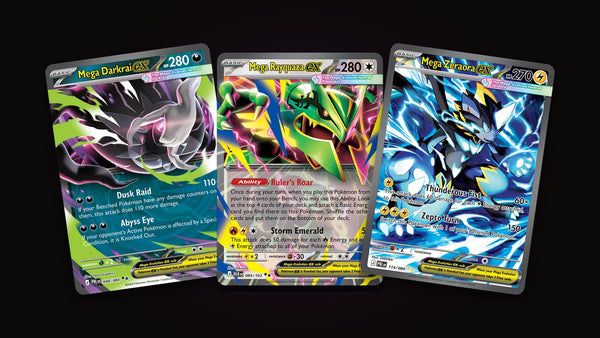
The best defence is knowing the real thing; The Pokémon Company recommends getting familiar with its official images so knockoffs stand out. Here are three genuine cards from the Mega Evolution—Pitch Black expansion.


How to tell if a Pokémon card is fake: 7 checks
1. Look it up in the official card database
Search the exact name in the free TCG card database on pokemon.com and narrow it by expansion. The artwork, HP, attacks, damage and illustrator should all match. An HP figure or attack that doesn't exist, or artwork borrowed from another card, points to a fake.
2. Check the set code, card number and small print
A genuine modern card's bottom corner carries precise small print: illustrator, regulation mark, set code and language, card number out of the set total, rarity symbol and the copyright line (Pokémon, Nintendo, Creatures, GAME FREAK). On fakes it is often blurry, misaligned or missing, or the number doesn't match the database.

3. Fonts, spelling and energy symbols
Counterfeiters often get the lettering wrong: a different typeface, letters too bold or thin, uneven spacing, spelling mistakes, or "Pokemon" without the accent. Energy symbols should be clean, round and the right colour.

4. The back of the card
Every English Pokémon TCG card shares the same blue back with the Poké Ball and yellow Pokémon logo. Put the suspect card next to a common you pulled yourself: on fakes the blue is often too light, too purple or washed out, the print blurry or the border uneven.
5. Holo, texture and finish
Many modern high-rarity cards have a fine textured surface you can feel, with the holo shine in specific places. Fakes are often completely smooth, overly glossy, or shine all over.
6. Card stock and the light test
Fakes often feel thinner, floppier or waxy. The Pokémon Company says counterfeit cards are often easy to see through when held up to a bright light, a quick, non-destructive check. Compare with a genuine common from the same era, as card stock varies between print runs.
7. The rip test: don't do it
The "rip test" means tearing a card in half to look at the layer inside. It destroys the card, so it only proves anything once the card is ruined. Use the checks above instead, or ask a local trading card shop for a second opinion, as Pokémon Support suggests.
Fake gold Pokémon cards
Gold-coloured foil or metal "Pokémon cards", often sold in sets online, are generally not official Pokémon TCG cards and won't be found in official booster packs. If a "gold card" isn't in the card database or an official product on pokemon.com, treat it as an unofficial novelty.
How to spot fake Pokémon booster packs and boxes
The Pokémon Company says fake booster packs can be very difficult to tell from real ones, so look at the whole picture:
- Price: a pack priced dramatically below suggested retail is, per Pokémon, a near-certain warning of counterfeits.
- Artwork and print: compare with the official images on pokemon.com; many knockoffs look nothing like the real packaging.
- Tampered packs: check the crimped ends. Uneven, glued, melted or wrinkled seams are red flags.
- Weighed or searched packs: loose packs from unknown sellers may have been weighed or picked over to remove likely hits.
- Shrink wrap on boxes: loose, baggy, re-taped or messily melted wrap suggests a re-wrapped box.
- Where it's sold: Pokémon Support says the highest reported instances of counterfeit sales come from flea markets.
Genuine Pitch Black packaging for reference: each English pack holds 10 game cards, 1 Basic Energy and a Pokémon TCG Live code card; a display box holds 36 packs.


Are Pokémon cards from Temu or Amazon real?
Marketplaces such as Temu and Amazon list products from many third-party sellers, so whether a Pokémon product is genuine depends on who is selling it. Before you buy on any marketplace:
- Check the seller: who is it sold by and shipped from: the brand, an authorised retailer, or an unknown third party?
- Read the reviews: check the seller's rating and buyer photos.
- Compare the price: far below the usual price is a warning sign.
- Check the listing photos: do the name, set and packaging match pokemon.com? Avoid vague titles like "random cards bundle".
- Protect yourself: choose a clear returns policy and a payment method with buyer protection.
The same checks apply to auction sites and social media sellers. Buying a valuable single? Our guide to what your Pokémon cards are worth explains how people check market value. Phoenix TCG doesn't give financial advice; prices change.
Buy genuine Pokémon cards from a trusted store in Ireland
The simplest way to avoid fakes is to buy from a shop supplied through official distribution. Phoenix TCG is an Irish store selling genuine Pokémon TCG products, shipped tracked from Dublin across the Republic of Ireland. Right now we have Pitch Black booster packs (€6.99) and the Pitch Black booster display box (€229.99) in stock, plus the rest of our Pokémon range. For more on where to shop, read where to buy Pokémon cards in Ireland.
Then protect it: see our guide on how to protect trading cards.


Stock up on penny sleeves (€4.99), toploaders (€6.99) or an acrylic booster box case (€19.99), and earn Gems on every order when you join our free membership.
Fake Pokémon cards FAQ
How can you tell if a Pokémon card is fake?
Compare it with the same card in the official card database on pokemon.com, then check the back, fonts, symbols, texture and small print. Pokémon also says fakes are often easy to see through under a bright light.
What does the back of a fake Pokémon card look like?
Fake backs often have blue that is too light, too purple or washed out, blurry printing or an uneven border. The easiest check is to place the card next to a genuine common you pulled from a pack yourself.
Are gold Pokémon cards real?
The gold foil or metal "Pokémon cards" sold in sets online are generally not official Pokémon TCG cards. If a card isn't in the official card database or part of an official product on pokemon.com, treat it as an unofficial novelty.
Does the rip test work on Pokémon cards?
Tearing a card shows the layer inside, but it destroys the card, so we don't recommend it. Use non-destructive checks such as the database comparison and the light test, or ask a local trading card shop.
Are Pokémon cards on Temu real?
Marketplaces like Temu list products from many third-party sellers, so it depends on the seller. Check who is selling it, read reviews, compare the price with the usual price and compare the packaging with the official images on pokemon.com.
Are Pokémon cards on Amazon legit?
Amazon lists products sold by Amazon and by third-party sellers. Check who the item is sold by and shipped from, read the seller's reviews, and be wary of prices far below the usual price for that product.
How do I know if a booster pack has been tampered with?
Check the crimped seams at both ends: uneven, glued, melted or wrinkled seams are a warning sign. Buying from a retailer supplied through official distribution avoids tampered or weighed packs.
Where can I buy genuine Pokémon cards in Ireland?
Phoenix TCG in Dublin sells genuine Pokémon TCG products from official distribution, including Pitch Black booster packs, shipped tracked from Dublin across the Republic of Ireland.
Guidance quoted from Pokémon Support ("Did I purchase fake or counterfeit cards?" and "How do I use the Trading Card Game database?"). Card images are official images from pokemon.com; product images are our own store listings. Pokémon is a trademark of Nintendo, Creatures and GAME FREAK; Ultra PRO is a trademark of Ultra PRO International. Temu and Amazon are trademarks of their respective owners; Phoenix TCG is not affiliated with either.
Collect with Phoenix TCG
Join free for 500 welcome Gems, earn Gems on every order and get early access to limited drops.
Join free